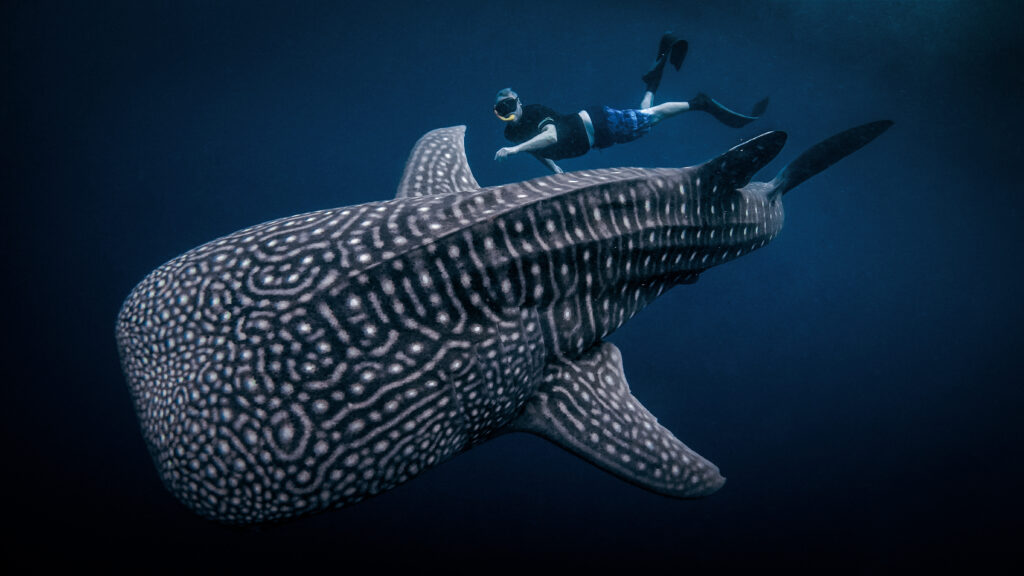
It’s strange how quiet the world gets when a whale shark appears beneath you.
I had read the guides, watched the videos, listened to every orientation, but nothing prepared me for that moment in Saleh Bay—the way everything fell silent inside my head as that slow, spotted shadow rose from the deep blue. It wasn’t fear. It was awe. The kind that doesn’t need to be explained because your whole body already understands: you are in the presence of something sacred.
That’s the word I keep coming back to—presence. Because swimming with a whale shark isn’t just about seeing a giant fish. It’s about recognizing that you’re in someone else’s home, and that they’ve allowed you a brief moment of grace within it.
A Journey That Makes You Earn It
Getting to Sumbawa from Lombok isn’t a simple detour. It’s not a pop-out-from-your-resort-for-a-few-hours kind of trip. You travel by sea, by road, sometimes both. You wake up early, you ride with the breeze on your face, you let the landscape unfold slowly.
And honestly, I think that’s part of the beauty. This isn’t a wildlife show packaged for convenience. It’s an experience that starts before you even see the animal. You’re stepping into a rhythm that doesn’t revolve around tourists. It revolves around the sea, the light, and the quiet movement of creatures who don’t care about our timelines.
That’s what makes it different. That’s what makes it earned.
There’s something deeply respectful about the way whale shark encounters are handled here. You don’t chase. You don’t lure. You wait. You observe. And if you’re lucky, you share a few minutes with one of the ocean’s most ancient beings.
That mindset—that quiet reverence—is exactly what sets a Saleh Bay whale shark tour apart.
A Glimpse Into a World Not Made For Us
We like to think the ocean is ours because we cross it. Fly over it. Dive into it for a few hours with fins and cameras. But being in the water next to a whale shark reminds you just how little of it we actually belong to.
They don’t need us. They’ve been gliding through the seas for millions of years, long before we built boats or dreamed of Instagram.
When you float beside a whale shark, you become part of a moment that isn’t about you. And that’s rare in travel.
You’re not the star. You’re not even the narrator. You’re just a witness to something that was happening anyway—and will continue long after you leave.
That humility, that shift in perspective, is the real gift of a genuine sumbawa whale shark from lombok experience.
Real Wildlife, Not Performance
One of the things I love most about whale shark encounters in Saleh Bay is that they’re natural. These animals aren’t trained. They aren’t baited. No one guarantees a sighting.
They appear if they want to.
And when they do, it feels like a gift.
You don’t get that feeling when animals are coaxed with food or corralled into “experiences.” But when a wild whale shark chooses to swim past your boat, unbothered and elegant, it stays with you. That kind of wild honesty can’t be replicated—and it shouldn’t be.
This isn’t a zoo. It’s a living sea. And that’s exactly how it should feel.
They Don’t Speak, But They Teach
Whale sharks don’t make sounds. They don’t have expressions we can read. But when you’re near one, you learn things anyway.
You learn patience.
You learn how to be still.
You learn how small you are—and how okay that is.
During my time in Saleh Bay, I noticed something strange: even the most talkative people got quiet in the water. Something about the presence of this slow-moving, 10-meter-long creature made everyone instinctively calm down. No shouting. No frantic flippers. Just people floating, breathing, and staring like kids seeing stars for the first time.
There’s something healing about that. Something deep. You don’t just see a whale shark. You feel it. And it stays in your bones.
Not Just a Tour—A Shared Space
What struck me most wasn’t just the whale sharks. It was the way the guides talked about them. Not as attractions, but as neighbors.
Local fishermen here have coexisted with these gentle giants for generations. The bagan (traditional fishing platforms) sit quietly in the bay, and the whale sharks often show up nearby, drawn by the natural presence of small fish. It’s not artificial—it’s an understanding.
That kind of cohabitation is rare in tourism. But in Saleh Bay, it’s the foundation. You get the sense that you’re not joining a show. You’re joining a way of life. One that’s been here long before you arrived, and will continue long after you leave.
That’s powerful. And it makes the entire experience feel more meaningful.
How the Journey Changes You
Before this trip, I thought I knew what responsible travel looked like. I packed my reef-safe sunscreen, said no to plastic, supported local. All the usual.
But something about being in the water with a whale shark—watching it move with such peace and purpose—made me realize that being a good traveler isn’t just about what you do.
It’s about how you are.
It’s in the way you wait quietly instead of asking when.
It’s in the way you follow instructions, even if no one is watching.
It’s in the way you float gently, even when your heart is pounding.
Those little things add up. They become the memory.
More Than a Destination
When people ask me what it was like to see a whale shark in the wild, I always pause. It’s hard to put into words.
It wasn’t adrenaline. It wasn’t checklist satisfaction. It was something softer. Slower. Deeper.
It was the realization that I was lucky. That I had been invited into a world not made for me. That the whale shark had appeared not because I wanted it to, but because it simply was.
And I happened to be there.
That’s what makes it an honor.
Not the photos. Not the story. But the moment itself. That tiny, perfect sliver of shared existence in a sea that doesn’t belong to us.
Letting the Ocean Lead
In a world of over-curated travel and over-promised experiences, it’s refreshing—no, essential—to find a place where nature still leads. Where the ocean still decides.
Saleh Bay is that kind of place.
If you’re looking for something real, something quiet, something that will live in your memory longer than any headline tour… consider making the journey.
Let the sea take its time. Let the whale sharks move how they please. Let yourself be the guest, not the director.
That’s how you’ll know you’ve found something worth remembering.
And if you’re starting the journey sumbawa whale shark from lombok, know this: it’s not just a trip. It’s an invitation to be part of something far bigger than yourself. Something ancient, wild, and deeply, beautifully